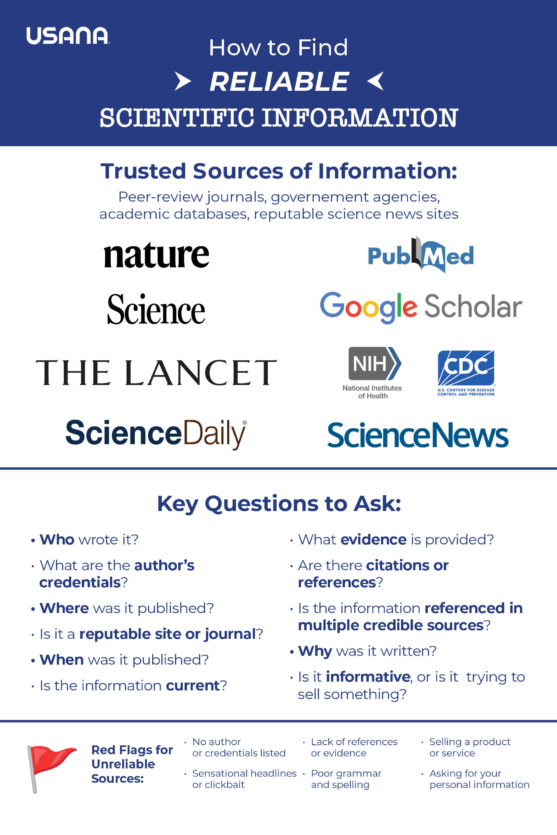
How to Find Reliable Scientific Information

Reliable science can help you make informed decisions. But with so much information available online, in social feeds, and through word of mouth, it can be difficult to know what deserves your trust.
The good news: you do not need to be a scientist to evaluate scientific information. A few simple questions can help you separate evidence-based guidance from exaggerated claims, outdated advice, or marketing disguised as education.
Start with the Source
- Peer-reviewed journals, where research is reviewed by experts before publication
- Government health agencies, which publish evidence-based public health guidance
- Academic databases, where you can search scientific studies and reviews
- Medical schools, universities, hospitals, and professional health organizations
- Reputable science news outlets that clearly explain where their information comes from
A trustworthy source should be transparent about who created the information, how it was reviewed, and whether it is meant to educate, persuade, or sell. For health topics, government and academic sources are often a strong place to begin because their content is typically reviewed for accuracy and updated as evidence changes.
- PubMed and other academic databases
- Centers for Disease Control and Prevention
- Peer-reviewed journals such as Nature, Science, and The Lancet
- Science-focused news organizations that cite original studies and expert sources
Ask Better Questions Before You Trust a Claim
When you come across a scientific or health claim, pause before you act on it or share it. Use these questions as a quick reliability check:
- Who wrote it? Look for an author, organization, or reviewer with relevant scientific or medical expertise.
- Where was it published? Check whether the information appears on a reputable website, journal, university page, or public health resource.
- When was it published or updated? Science changes as new evidence becomes available, so current information matters.
- What evidence is provided? Reliable articles should cite studies, official guidance, or expert review rather than relying only on personal stories.
- Do other credible sources agree? A claim is stronger when it is supported by multiple high-quality sources.
- Why was it written? Consider whether the goal is to educate, entertain, persuade, or sell a product or service.
Watch for Red Flags
Some information may sound scientific at first, but certain warning signs should make you slow down and look for better evidence.
- No author, reviewer, or credentials are listed
- The headline uses sensational language, fear, or “miracle” claims
- The article makes sweeping promises without explaining the evidence
- References are missing, unclear, outdated, or unrelated to the claim
- Personal testimonials are presented as proof
- The content is mainly trying to sell a product, service, or subscription
- The site asks for unnecessary personal information
- Poor grammar, broken links, or a lack of contact information make the source difficult to verify
Understand the Difference Between Evidence and Anecdote
Anecdotes can be interesting, but they are not the same as scientific evidence. A personal story may describe one person’s experience, while research looks for patterns across many people under controlled conditions. Stronger evidence usually comes from well-designed studies, systematic reviews, and guidance from qualified organizations that consider the full body of research.
Use Science as a Starting Point, Not a Substitute for Professional Care
Reliable information can help you ask better questions and make more informed choices. But online information cannot replace personalized advice from a qualified healthcare professional. If a claim could affect your medications, medical care, diet, supplements, or health routine, discuss it with your doctor, pharmacist, or another trusted healthcare provider.
Pre-bunking to Avoid Debunking
One of the best ways to protect yourself from misinformation is to prepare before you encounter it. This is sometimes called pre-bunking: learning common misinformation tactics in advance so they are easier to recognize later.
For example, unreliable health claims often use emotional language, promise quick fixes, rely on personal testimonials, or suggest that “the truth” is being hidden from the public. When you know these patterns ahead of time, you are less likely to be persuaded by them in the moment.
Pre-bunking does not mean dismissing new ideas automatically. It means building healthy skepticism. Before believing or sharing a claim, pause and ask: Does this source provide credible evidence? Are other reputable sources saying the same thing? Is the claim trying to inform me, scare me, or sell me something?
By practicing these habits, you can make misinformation less convincing before it has a chance to take hold.
AI as a Research Tool
Artificial intelligence can be a useful starting point when you are learning about a health or science topic. It can summarize complex information, define unfamiliar terms, and provide a jumping-off point for deeper thinking. But AI is only as reliable as the information it uses. You can use many of the techniques that help identify reliable information to help ensure the information presented through AI is complete, up-to-date, and accurate.
- Ask for evidence-based sources. Tell the AI tool to use peer-reviewed research, government health agencies, academic institutions, or other trusted sources when answering your question.
- Be specific about what you want to know. Narrow your prompt by including the health topic, population, outcome, or type of evidence you are looking for.
- Check where the information came from. If the answer includes sources, review them yourself. Are they reputable, current, and relevant to the claim?
- Confirm important claims outside the AI tool. Compare the answer with trusted scientific or medical sources before using it to guide a health decision.
A stronger prompt gives AI better boundaries. Compare these examples:
- Too broad: Does turmeric help?
- More useful: Using peer-reviewed human studies and reputable medical sources, what does the current evidence say about turmeric or curcumin for joint discomfort? Please summarize the quality of the evidence, possible limitations, and whether the findings apply to dietary supplements.
- Too vague: Is a fish oil supplement safe?
- More useful: What safety considerations are commonly discussed for fish oil supplements, including possible side effects, medication interactions, and groups of people who should speak with a healthcare professional before using it?
- Too leading: How does vitamin C help keep you from getting sick?
- More useful: What does current scientific evidence say about vitamin C and normal immune function? Please include whether the evidence comes from human studies, animal studies, cell studies, or expert reviews.
- Too general: What diet is best?
- More useful: What do reputable health organizations say about balanced eating patterns for generally healthy adults? Please focus on broad principles rather than strict rules or one-size-fits-all advice.
- Too final: Should I stop taking my medication and try a different health routine instead?
- More useful: What questions should I ask my doctor or pharmacist before making changes to my medication, supplement, or health routine?
AI can help organize information, but it should not replace your own critical thinking—or advice from a qualified healthcare professional. Use it to clarify concepts, identify reputable sources, and build better questions. Then verify the answer using the same reliability checks you would apply to any scientific claim: source, evidence, date, agreement among credible references, and purpose.
The Takeaway
Finding reliable scientific information takes practice, but the process is straightforward: check the source, look for evidence, confirm the date, compare credible references, and be cautious of claims that sound too simple or too dramatic. The more carefully you evaluate information, the more confidently you can use science to support everyday health decisions.